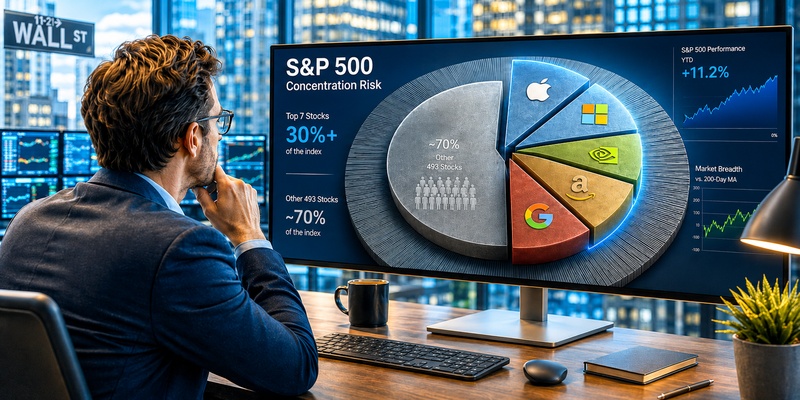
Buying an S&P 500 index fund is often described as one of the simplest ways to diversify. Instead of attempting to select individual winners, investors receive exposure to approximately 500 of America’s largest companies through a single investment.
But owning 500 companies does not necessarily mean your money is evenly divided among them.
The S&P 500 is weighted by market capitalization. This means the largest companies receive the largest positions in the index. As a company’s stock-market value increases, so does its influence over the index’s performance.
That structure has produced an unusually concentrated market.
Seven Companies, One-Third of the Index
As of July 2026, Nvidia, Apple, Microsoft, Amazon, Alphabet, Meta Platforms and Tesla collectively represent approximately 32% of the S&P 500. Nvidia and Apple alone account for around 15%.
Therefore, someone with €10,000 invested in an S&P 500 fund may effectively have more than €3,000 tied to these seven businesses.
The concentration is even clearer when examining sectors. Information technology represented approximately 38% of the index as of June 30, 2026. Financials, the second-largest sector, accounted for less than 12%.
Even that figure understates technology’s broader influence. Amazon and Tesla are classified as consumer-discretionary companies, while Alphabet and Meta are classified under communication services. Nevertheless, their results remain heavily connected to digital advertising, cloud computing, artificial intelligence and technology spending.
Why Concentration Is Not Automatically Bad
High concentration does not mean the S&P 500 is broken or destined to crash.
Market-cap weighting allows successful businesses to become larger positions automatically. Investors who owned index funds benefited enormously as companies such as Microsoft, Apple and Nvidia expanded their earnings and market values.
The leading companies are also not identical to the speculative internet businesses associated with the dot-com bubble. Today’s largest stocks generally produce substantial revenue, profits and cash flow.
Selling an S&P 500 fund simply because its biggest companies have performed well could create taxes, disrupt a long-term plan and cause an investor to miss additional growth.
The real issue is not whether these companies are good businesses. It is whether investors understand how much exposure they already have.
The Hidden Portfolio Overlap
Concentration becomes more serious when an investor owns an S&P 500 fund alongside a Nasdaq-100 fund, technology ETF or several individual mega-cap stocks.
Someone may believe that holding four or five investments creates diversification. In reality, each position may own many of the same companies.
A portfolio containing an S&P 500 fund, a growth-stock ETF and individual shares of Nvidia, Apple or Microsoft could be making a much larger technology bet than its owner realizes.
Morningstar notes that the ten largest US stocks now represent more than one-third of the market, compared with approximately 18% a decade earlier. This leaves index portfolios more vulnerable when a small number of dominant companies decline.
What Index Investors Can Do
Investors do not necessarily need to abandon the S&P 500. Instead, they should examine their complete portfolio.
Start by checking the largest holdings in every fund you own. Look beyond the fund names and identify repeated companies and sectors.
Investors seeking broader diversification could complement an S&P 500 position with international stocks, US small- or mid-cap companies, value-oriented funds or high-quality bonds. An equal-weight S&P 500 fund is another option, although it may have higher costs, more turnover and different performance than the traditional index.
Most importantly, avoid making sudden changes based on predictions about when technology stocks will fall.
The S&P 500 still provides exposure to hundreds of profitable companies. However, it should no longer be viewed as 500 equally important investments. Today’s index is increasingly driven by a small collection of exceptionally large businesses.
Owning the S&P 500 remains a legitimate long-term strategy. Just recognize what you actually own: a diversified US large-company fund with a significant—and historically unusual—bet on a handful of technology-driven giants.