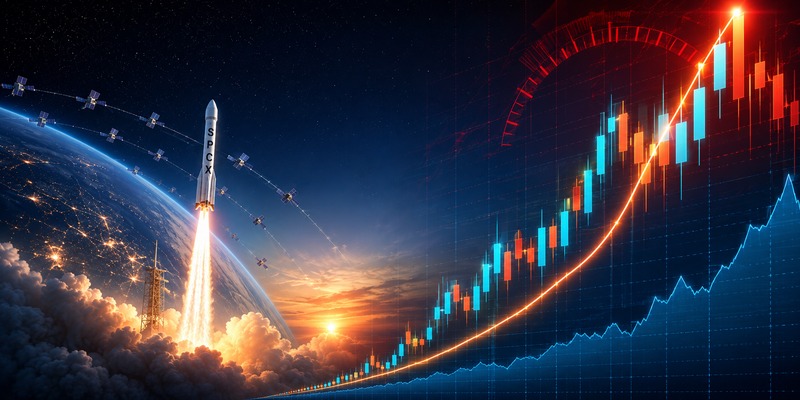
SpaceX is finally public under the ticker SPCX, and investors are already asking the obvious question: is this a once-in-a-generation opportunity, or has the market already priced in too much of the dream?
As of the latest market data, SPCX trades around $148.30 per share, giving SpaceX a market capitalization of approximately $1.97 trillion. That is the updated valuation investors are dealing with right now—not a private-market estimate, not an IPO rumor, but the public-market price tag. SpaceX listed at an offer price of $135, meaning the stock is still above its IPO price, though well below its post-listing high of $225.64.
The bull case is easy to understand. SpaceX is not just another aerospace company. It combines reusable rockets, Starlink satellite internet, launch services, defense contracts, and the long-term potential of Starship. If Starship works at scale, it could dramatically lower the cost of reaching orbit and open the door to industries that barely exist today. That is why some investors see SpaceX less like a traditional rocket company and more like early Amazon, Tesla, or Nvidia: expensive at first glance, but potentially cheap if the market it creates becomes enormous.
Wall Street is also leaning optimistic. TradingView shows that 18 of 19 analysts rate SPCX a Buy, with targets ranging from $131 to $800. Barron’s also reported that analysts are using very different assumptions, with some price targets implying multi-trillion-dollar valuations. That wide range tells investors something important: SpaceX is difficult to value because the company is part current business, part future infrastructure bet.
But the valuation is also the biggest risk. At nearly $2 trillion, SpaceX is already valued like one of the most important companies on Earth. Yet its reported financials still show early-stage pressure: TradingView lists fiscal-year revenue of about $18.67 billion and net income of approximately negative $4.94 billion. That does not mean SpaceX is weak, but it does mean today’s valuation depends heavily on future growth, future margins, and future execution.
In other words, investors are not paying for what SpaceX is today. They are paying for what SpaceX might become.
That is where caution matters. A great company can still be an expensive stock. If Starlink growth slows, launch margins disappoint, Starship faces delays, or government contracts become less favorable, SPCX could struggle to justify its valuation. The stock is also volatile: it recently traded more than 13% lower on the week, and its beta is listed at 7.46, suggesting sharp price swings may be part of the package.
So, is SPCX once-in-a-generation or already too expensive?
The honest answer: possibly both.
SpaceX may be one of the most important companies of the next 20 years. But at a valuation near $1.97 trillion, investors are already paying for a large part of that future. For long-term believers, SPCX may deserve a place on the watchlist—or a small, carefully sized position. But for value-focused investors, the smarter move may be patience. The company may be extraordinary, but the stock already demands extraordinary results.