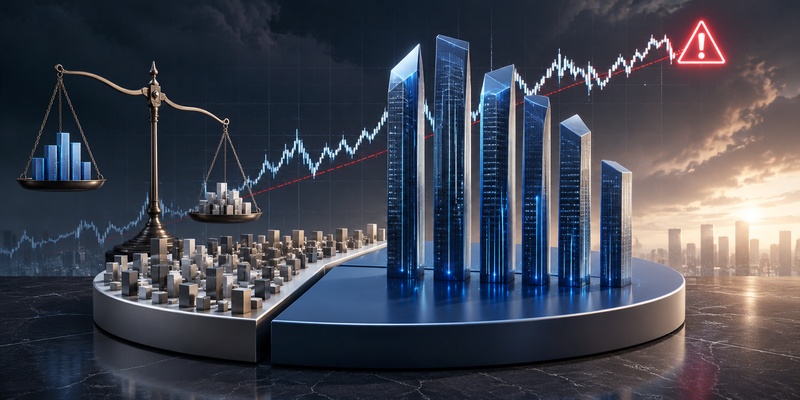
Technology-focused index funds have delivered extraordinary gains, largely powered by a small group of dominant companies. That success has also raised an uncomfortable question: are investors buying a diversified fund—or placing an increasingly large bet on the same seven stocks?
The “Magnificent 7”—Apple, Microsoft, Nvidia, Amazon, Alphabet, Meta and Tesla—represented roughly one-third of the S&P 500’s total market value in June 2026. Their influence can be even greater inside technology and Nasdaq-focused funds.
That is genuine concentration risk. But concentration alone does not prove that the market is in a bubble.
Why Tech Index Funds Became So Concentrated
Most major index funds are weighted by market capitalization. The larger a company becomes, the more heavily the fund invests in it.
This system naturally rewards winners. When Nvidia, Microsoft or Apple rises faster than the rest of the market, its index weight increases automatically. Investors are not necessarily choosing to buy more of that company—the index methodology is doing it for them.
The Nasdaq-100, for example, tracks 100 of the largest non-financial companies listed on Nasdaq. Despite the number in its name, its returns can be heavily influenced by a relatively small group of enormous businesses.
Is This Another Dot-Com Bubble?
There are similarities. Investors are excited about a transformative technology, valuations are elevated and money is flowing toward a narrow group of perceived winners.
However, today’s largest technology companies are not speculative startups with little revenue. They generate substantial earnings, cash flow and economic profits. Research from Russell Investments found that the biggest companies’ unusually large market weights have been supported by strong profit margins, returns on equity and earnings power.
The better conclusion is not that there is definitely a bubble. It is that expectations are extremely high.
A company can remain profitable, innovative and dominant—and still produce disappointing stock returns if investors paid too much for its future growth.
What Concentration Risk Actually Means
Concentration works in both directions.
When the largest technology companies outperform, index investors benefit considerably. But when those companies decline together, owning dozens or even hundreds of other stocks may provide less protection than expected.
The Magnificent 7 also share several overlapping risks:
- Heavy spending on artificial-intelligence infrastructure
- Regulatory and antitrust scrutiny
- Dependence on digital advertising, cloud computing or consumer technology
- High valuations that require continued earnings growth
- Sensitivity to interest rates and changing investor sentiment
A technology index may therefore appear diversified by company count while remaining concentrated by business model, valuation and economic exposure.
Should Investors Avoid Tech Index Funds?
Not necessarily. These funds still provide exposure to some of the world’s strongest and most innovative businesses. Selling simply because the market looks concentrated could mean abandoning long-term growth companies prematurely.
The more important question is how much of your total portfolio depends on them.
Someone who owns a technology fund, an S&P 500 fund and a growth-stock fund may believe they hold three different investments. In reality, all three may have their largest positions in the same companies.
Rather than trying to predict exactly when a bubble will burst, investors can reduce dependence on a single market theme by adding exposure to smaller companies, value stocks, international markets, bonds or equal-weighted funds.
The risk is not that the Magnificent 7 are automatically bad investments. It is that investors may own far more of them than they realize.